
The Colors of Fortune: A Conversation with Mitomi-san on Tairyō-bata in Miura
In the quiet coastal town of Miura, Kanagawa Prefecture, a centuries-old craft still thrives—one that fills harbors with vibrant color and carries the prayers of fishermen to the sea. These are Tairyō-bata, the great “big catch flags” that once signaled home to families waiting on shore and continue today as powerful symbols of celebration, good fortune, and community.
I visited the workshop of Mitomi-san, a seventh-generation craftsman to watch him at work and to better understand the artistry, history, and symbolism woven into every flag.
The Origins of the Tairyō-bata
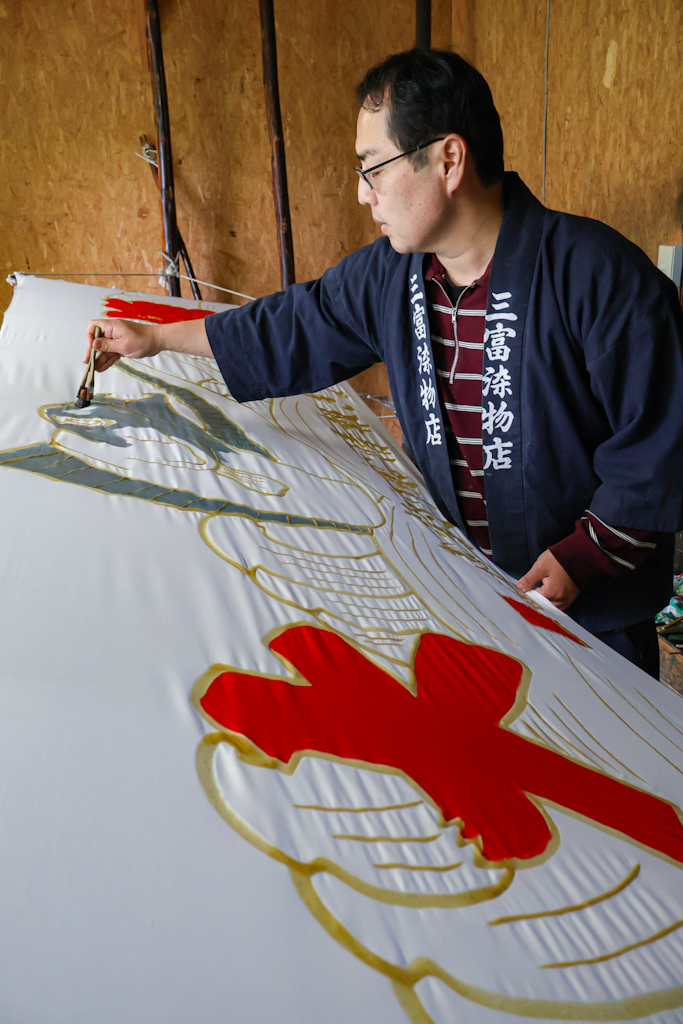
“Originally, these flags were very simple,” he explained while deftly applying paste to cloth. “Fishermen would hoist a flag to tell their families they had returned with a big catch. All it needed was the name of the boat, the word ‘大漁’ (tairyō, ‘big catch’), and the name of the sender. No pictures—just words bold enough to be read from far away.”
Over time, designs grew more elaborate, incorporating auspicious motifs: cranes and turtles for longevity, treasure ships for a prosperous voyage, and of course, red sea bream—tai—for their happy play on words with omedetai(congratulations).
“Even today,” he added, “when a couple marries, many people ask for treasure ships or cranes and turtles on their flags to mark a new beginning.”
The Craft Behind the Flag
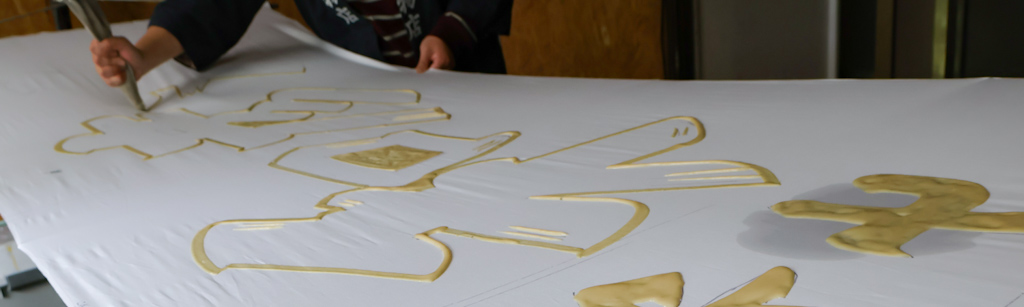
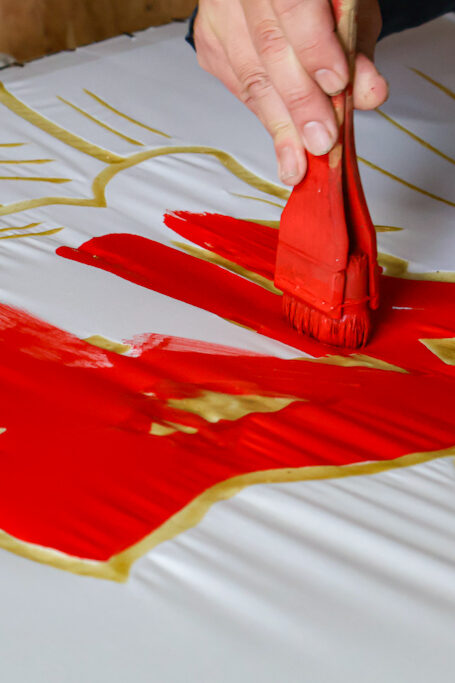
The making of a Tairyō-bata begins with a blank sheet of white cloth. Onto this, the artisan sketches an outline before applying norioki—a resist paste made by boiling sticky rice and mixing it with rice bran. Using a handmade tube not unlike a cake decorator’s piping bag, he squeezes the paste along every line of the design. Once dry, these resist lines will keep colors separate, preserving crisp white borders when the paste is later washed away.
“This step is the heart of the craft,” he told me. “If the paste is wrong, nothing else will work. It must be placed firmly but quickly—if it dries before we fix it with water from the back, it won’t hold.”
The rhythm of the work reminded me of calligraphy—controlled, confident strokes that reveal both skill and years of practice. “I’ve been making flags for about 20 years,” he said. “At first, it was slow and clumsy. Now it feels natural, but even today, small characters or tight spaces take time.”
Playing with Color
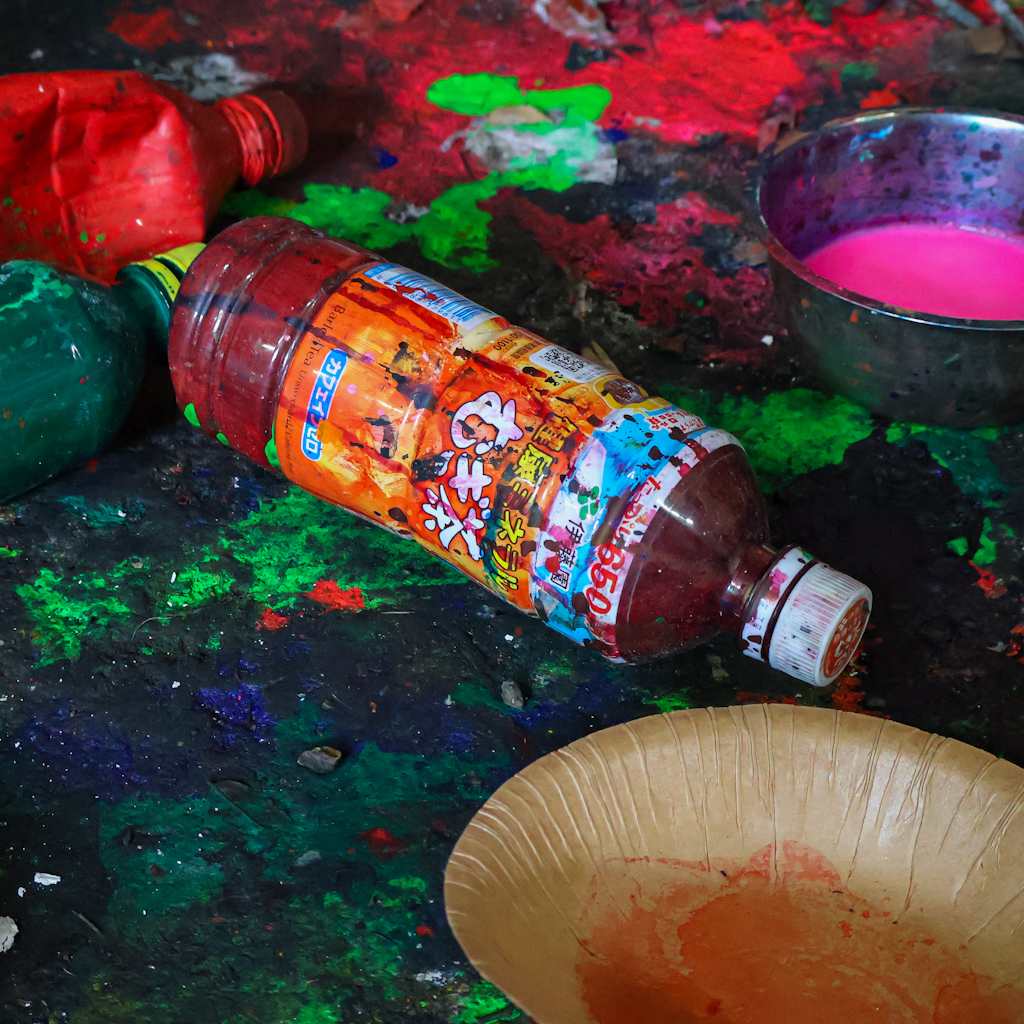
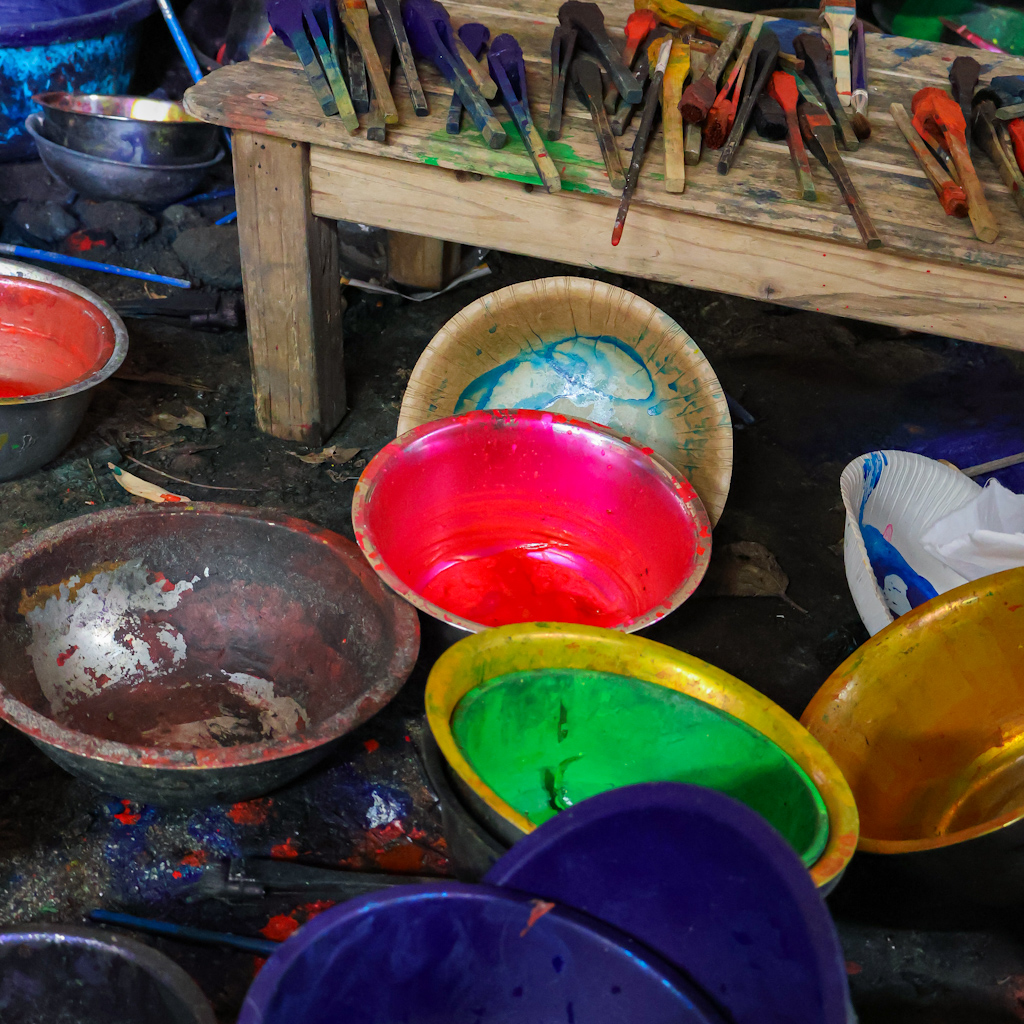
Once the outlines are fixed, the painting begins. Bright pigments, sometimes mixed with natural dyes, are brushed across the fabric in wide, sweeping motions.
“Color balance is important,” he explained. “If twenty or thirty flags are raised at once, it looks dull if the colors are all the same. So we vary them.”
There are traditions, of course: ship names are usually painted in black—“to bring strength, so the name ‘holds fast’”—while red is avoided for names but welcomed for the word “大漁.”
“Red without context feels unlucky. But for ‘big catch’? It’s perfect. Without red, the flag looks lifeless.”
He smiled when I asked about his personal preference. “Bright yellow-green,” he said without hesitation. “It adds light.”
From Edo-Era Banners to Fishermen’s Flags
Though Tairyō-bata are now iconic symbols of Japan’s coastal culture, they are relatively recent in origin, dating back to the late Taishō and early Shōwa periods. Before that, the family worked as official craftsmen for the shogunate, using the same resist-dyeing technique to produce banners bearing samurai crests.
“Because we lived by the sea, we naturally began making flags for fishermen too,” he said. “The technique is the same—we also make shop curtains in the same way.”
Their records trace the family’s craft back to Tenpō 4 (1833), and he is proud to stand today as the seventh generation.
Community and Celebration
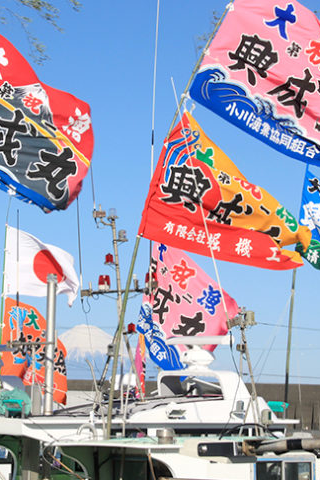
In the past, flags were raised only when a boat returned laden with fish. Today, they serve mainly for celebrations: the launching of a new vessel, New Year festivities, or even weddings.
“When a new boat is built, friends and associates will send twenty to thirty flags as gifts,” he said. “In the days when Miura’s tuna fleet was at its peak, there were boats flying a hundred flags at once—some of them as large as eight tatami mats (over three meters across). Imagine the sight!”
These occasions often include festive rituals: at a launching ceremony, rice cakes are thrown from the boat into the crowd, while in New Year’s celebrations, mandarins are tossed to bring good luck for the first catch. Children, of course, delight in these traditions.
The Artisan’s Philosophy
Asked which part of the process he enjoys most, the craftsman paused. “I never really thought about it in terms of fun,” he admitted. “But if I had to say—laying the paste. With every stroke, the form comes alive. I prefer it even to painting.”
Watching him work, I could see what he meant: there was joy in the steady flow of paste, each line marking the emergence of the design beneath.
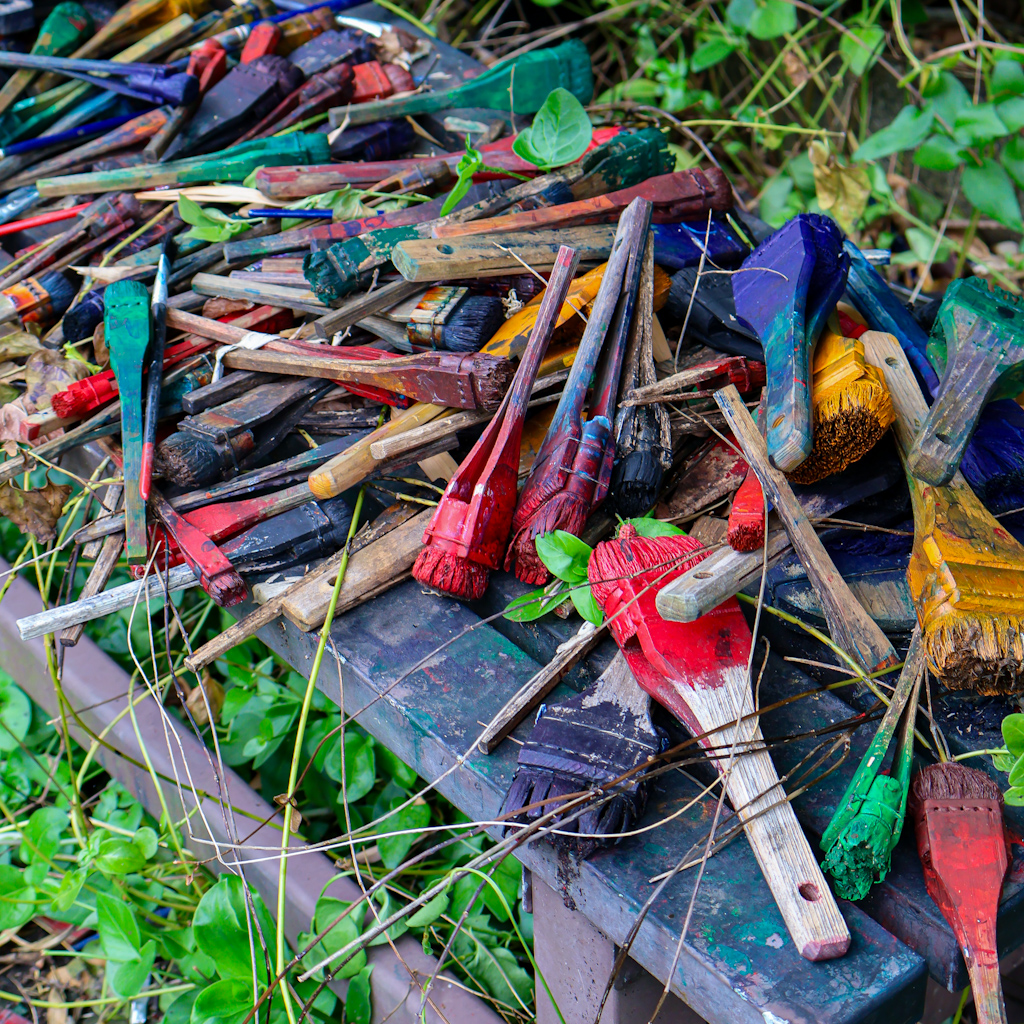
The tools are simple yet deeply personal. He makes his own piping tubes, combining cloth with a bought tip. Brushes are often crafted from deer hair. Even the paste itself is tuned to the season—more bran in winter for firmness, less in summer for softness.
“It may look simple from the outside,” he said, “like decorating a cake with cream. But to make a flag that lasts, every detail matters.”
A Living Tradition
Despite its long history, the craft is still evolving. Clients today sometimes request unusual designs—portraits, slogans, or personalized symbols. One memorable commission, he recalled with a laugh, was for a flag featuring a caricature and the words “Looking for a bride!”
And while most customers are Japanese, foreign visitors are increasingly drawn to the workshop. “Even with my broken English, we manage,” he said. “Sometimes interpreters can’t keep up, but foreigners often learn just by watching. This is handwork—it crosses language.”
In this way, the craft continues to bridge past and present, land and sea, Japan and the world.
The Future of Tairyō-bata
As I left the workshop, the day’s freshly painted flags hung outside to dry—bright strokes of pink, orange, and yellow against the coastal air. Soon they would flutter above a brand-new fishing boat, carrying with them wishes for prosperity, safety, and happiness.
“Ultimately,” he said, “it’s about sending prayers. For good catches. For safe returns. For new beginnings. That hasn’t changed.”
In every Tairyō-bata, then, lies more than fabric and dye. There is history, devotion, and a splash of hope—flying boldly against the wind.
Hands-On Experience: Paint Your Own Tairyō-bata
At the workshop, visitors can enjoy a hands-on Tairyō-bata painting experience. Pre-outlined flags with paste already applied are prepared in advance, and guests choose and paint their own background colors and motifs to bring the flag to life.
The process typically takes around one to one and a half hours, guided step by step by the craftsman. Even those without artistic experience—or without Japanese language skills—can easily join in. “It’s handwork,” the artisan smiled, “you can learn just by watching.”
The finished piece makes for a vivid and truly personal souvenir of Japan’s coastal traditions. To make a reservation, you can do it directly through the artisan’s website or phone number, or send me an email for english support — all contact info are written below.
Custom-Made Tairyō-bata
The workshop also accepts custom orders, creating one-of-a-kind flags for special occasions. Weddings, store openings, anniversaries, and especially the launching of new fishing vessels are common reasons for commissioning a flag.
Clients can request traditional motifs such as cranes, turtles, treasure ships, or sea bream for good fortune—or choose something modern and playful. “Once, someone asked for a caricature with the words ‘Looking for a bride!’” the artisan recalled with a laugh.
Sizes vary from smaller decorative flags to dramatic banners measuring over three meters across, once flown proudly on tuna boats. Each flag is infused with care, symbolism, and individuality, making it a powerful gift and a lasting keepsake.
If you would like to place a custom order, feel free to send me an email (address below).
General Information
Address: 1-10-9 Misaki, Miura City, Kanagawa Prefecture, 238-0243
Access: Approx. 90 min from Shinagawa Station, Keikyū Line to Misakiguchi Station, then local bus or taxi
Hours: 8:00 AM – 8:00 PM
Closed: National holidays (irregular closures during New Year)
Contact: 046-881-2791
English contact: noemie@makesweb.com
Website: https://www.m-some.com/